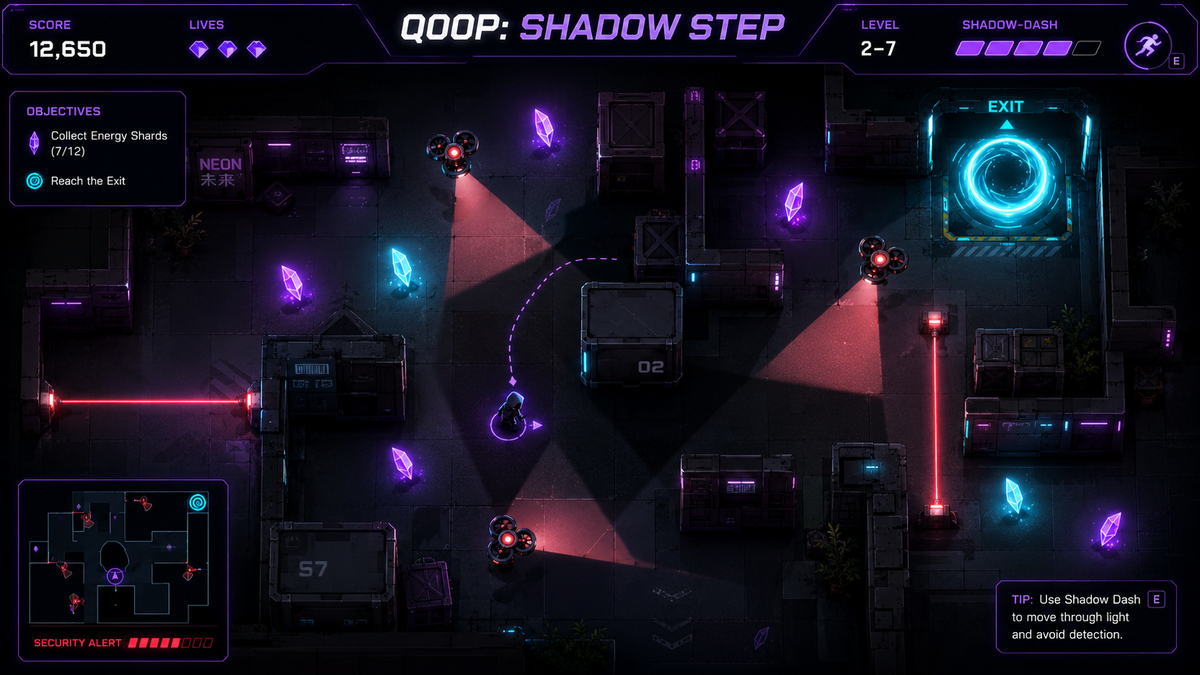
 Q00P: Shadow Step
Arcade
Q00P: Shadow Step
Arcade
Shadow Step presents a route on a sixteen-cell board, hides it, and asks the player to reproduce every tile in the same order. Each successful response adds another step to the next demonstration. The challenge grows through sequence length while the board, controls, and feedback remain familiar.
Observation and input are separated
During the demonstration phase, the useful action is to watch. The board then changes state before accepting the response. Separating those phases prevents a tap made during observation from becoming an accidental answer and gives the player a clear moment to switch from receiving information to recalling it.
The illuminated tiles appear one at a time. That pace makes order visible and allows a route to be understood as movement rather than as several unrelated flashes. A player can notice that the path turns a corner, crosses the center, returns to an earlier row, or forms a small shape.
Shapes are easier than isolated positions
Remembering a long string of tile numbers demands more mental effort than remembering a few connected ideas. Grouping the route into shapes creates those ideas. Three tiles might form an L. Four might trace a square edge. A jump from one side to another can become a named transition between two groups.
Directional language offers a second memory channel. Quietly describing a sequence as “down, right, corner, back” can reinforce the visual pattern. The words do not need to identify every tile perfectly; they only need to preserve enough structure to rebuild the route in order.
Growth remains understandable
A correct response adds one new step rather than replacing the entire rule set. The player sees the familiar opening route and then one additional position. This lets memory grow incrementally and gives each round a direct relationship to the previous one.
A wrong tile ends the run immediately. Clear failure feedback matters because sequence games become confusing when the player cannot tell whether the mistake was an incorrect position or an incorrect order. One definitive result keeps the next attempt focused.
A repeatable recall method
Watch the first few tiles and name the initial shape. When more tiles appear, divide the route at a natural turn or large jump. Rehearse the groups once during the brief transition, then enter them without rushing.
Keep the cursor or finger away from the grid while observing. During recall, select each tile deliberately and avoid looking ahead so far that the current position is lost. When a route becomes too long, preserve its boundaries first: remember where each group begins and ends, then reconstruct the shorter movements inside each group.
Shadow Step uses a small board to make the state easy to see, but the expanding route ensures that attention and organization continue to matter. The aim is not photographic memory. It is learning how to convert a changing visual sequence into a few stable, repeatable patterns.