Build this guide was checked against
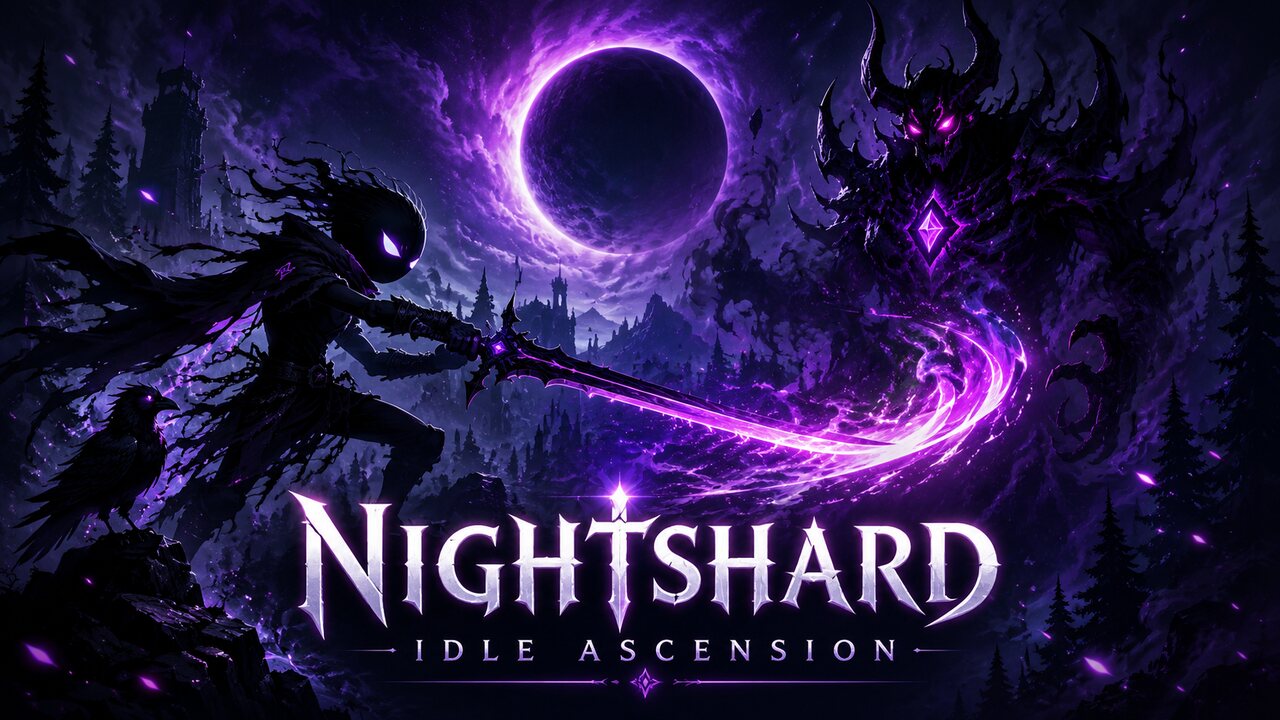
This guide is written against the current Q00P runtime package for NIGHTSHARD: Idle Ascension: build 1.1.0, release ID 20260819051533-kxehd8u8j7otjayr. The package was validated on August 19, 2026. Its release README records a passing runtime-syntax check, unique hashes for the four embedded WebP art containers, a successful save encode/decode round trip, a successful squad-wave transition from wave 1 to wave 2, and a successful Antler King boss transition into Stage 2.
Those checks are package-level evidence for the build described below. They are not a substitute for separate browser/device testing, so this guide only makes claims that can be traced to the current game data and runtime package.
Choose a Warden by combat trade-off
NIGHTSHARD starts with four Warden classes. They share the same long-term progression systems, but their class statistics and Arts push them toward different combat rhythms.
Nightblade
Nightblade is the fastest critical-oriented option. Its class data emphasizes attack speed and critical pressure at the cost of lower health. Its four Arts are Moonrend, Veil Step, Fallen Stars, and Total Eclipse. Use Nightblade when you want frequent active-skill cycles and are comfortable relying on damage tempo rather than raw durability.
Iron Warden
Iron Warden is the defensive specialist. Its package data gives it the strongest health and armor multipliers of the four classes, and Living Aegis adds a healing component to its kit. Realm Breaker, Living Aegis, Faultline, and Last Judgment reward a slower, sturdier approach that is useful when a boss survives long enough to punish fragile builds.
Starcaller
Starcaller focuses on spell damage and faster skill recovery. Astral Nova, Twin Comet, Timefold, and White Supernova give the class several burst windows. Timefold is especially important because its runtime description explicitly accelerates cooldowns after dealing damage.
Riftcaller
Riftcaller leans into life drain, companion synergy, and summoned-shadow flavor. Its Arts are Rift Fang, Crow Murder, Devouring Maw, and The Wild Hunt. Rift Fang and Devouring Maw both include healing behavior in the current runtime data, making Riftcaller a useful middle ground between sustained offense and self-recovery.
Understand the five-wave encounter structure
The current 1.1.0 release changed ordinary combat into real squad waves. Normal waves contain two to four enemies, while wave 5 is the boss encounter. The release package specifically validates the Shiverwood Antler King transition into Stage 2.
The five realm definitions in the current build are Shiverwood, Ember Waste, Drowned Spire, Glass Desert, and Eclipse Throne. Each realm has its own normal-enemy set and boss definition. That means a build that clears early Shiverwood squads comfortably still has to survive a timed boss before progression continues.
During combat, automatic attacks keep pressure on the current enemy, while the three equipped active Arts remain player-controlled. Saving all three abilities for a boss is often stronger than spending every cooldown as soon as it becomes available.
Build power in layers instead of one stat
Gold can be spent on eight Growth attributes covering attack, health, regeneration, attack speed, armor, critical chance, critical power, and skill power. Equipment occupies six slots, and the runtime also includes companions and relics.
A practical early route is:
- Raise Attack and Attack Speed until normal squads stop slowing progression.
- Add Health or Armor if boss timers become survival checks rather than damage checks.
- Equip stronger drops instead of holding weak inventory pieces for too long.
- Use Equip Best after several drops, then inspect whether the result still matches the class you are building.
- Salvage unused Common and Rare gear when the extra gold is more valuable than inventory depth.
- Treat companions, relics, and later Ascension bonuses as long-term layers rather than replacements for basic Growth upgrades.
Know what Eclipse Ascension resets
Eclipse Ascension becomes available from Stage 10. The current runtime presents it as a deliberate progression reset for permanent Eclipse Sigils.
The confirmation logic is explicit about the reset boundary: Stage, Level, Gold, and Growth upgrades are reset. Equipment, skills, allies, relics, Moon Shards, achievements, and best-stage progress are preserved. The Sigils earned by Ascension permanently raise attack and maximum health.
That makes Ascension most useful when the cost of forcing another stage is higher than the value of restarting with permanent power. Remaining stuck on one boss indefinitely is usually weaker than converting progress into Sigils and rebuilding more quickly.
Use offline gains as a return bonus, not the main strategy
NIGHTSHARD calculates offline rewards when the game returns after being hidden or closed. The current build caps offline gain at eight hours and can award gold, experience, and gear caches.
Offline gains help the next active session start stronger, but boss timing, equipment decisions, Growth allocation, and Ascension remain active progression decisions. The build is an idle-action hybrid rather than a game where every important choice disappears once auto-battle is enabled.
Protect progress with the current save system
Build 1.1.0 keeps save schema version 1. The primary and backup browser-storage keys remain nightshard_save_v1 and nightshard_save_backup_v1.
The runtime wraps save data in a checksum envelope, reads from the primary and backup slots, and periodically writes progress while the state is dirty. It also saves on page-hide and before-unload events. The Settings panel exposes manual export and import so a player can keep a portable recovery copy.
For a safer long-term run:
- Export a manual backup before changing browser profiles or devices.
- Keep the text backup until the new session has loaded correctly.
- Do not edit the exported payload unless you are prepared for the checksum validation to reject it.
- Use the in-game reset only after exporting anything you may want to restore.
A practical progression loop
A strong NIGHTSHARD session is not just “leave auto-battle running.” Let normal squads generate gold and drops, spend that income where the current class is weak, preserve active Arts for dangerous boss windows, improve gear and permanent systems, and Ascend when the next stage is no longer efficient.
This guide is tied to Q00P build 1.1.0 and release ID 20260819051533-kxehd8u8j7otjayr so future balance or save changes can be documented against a known package rather than silently changing the advice.