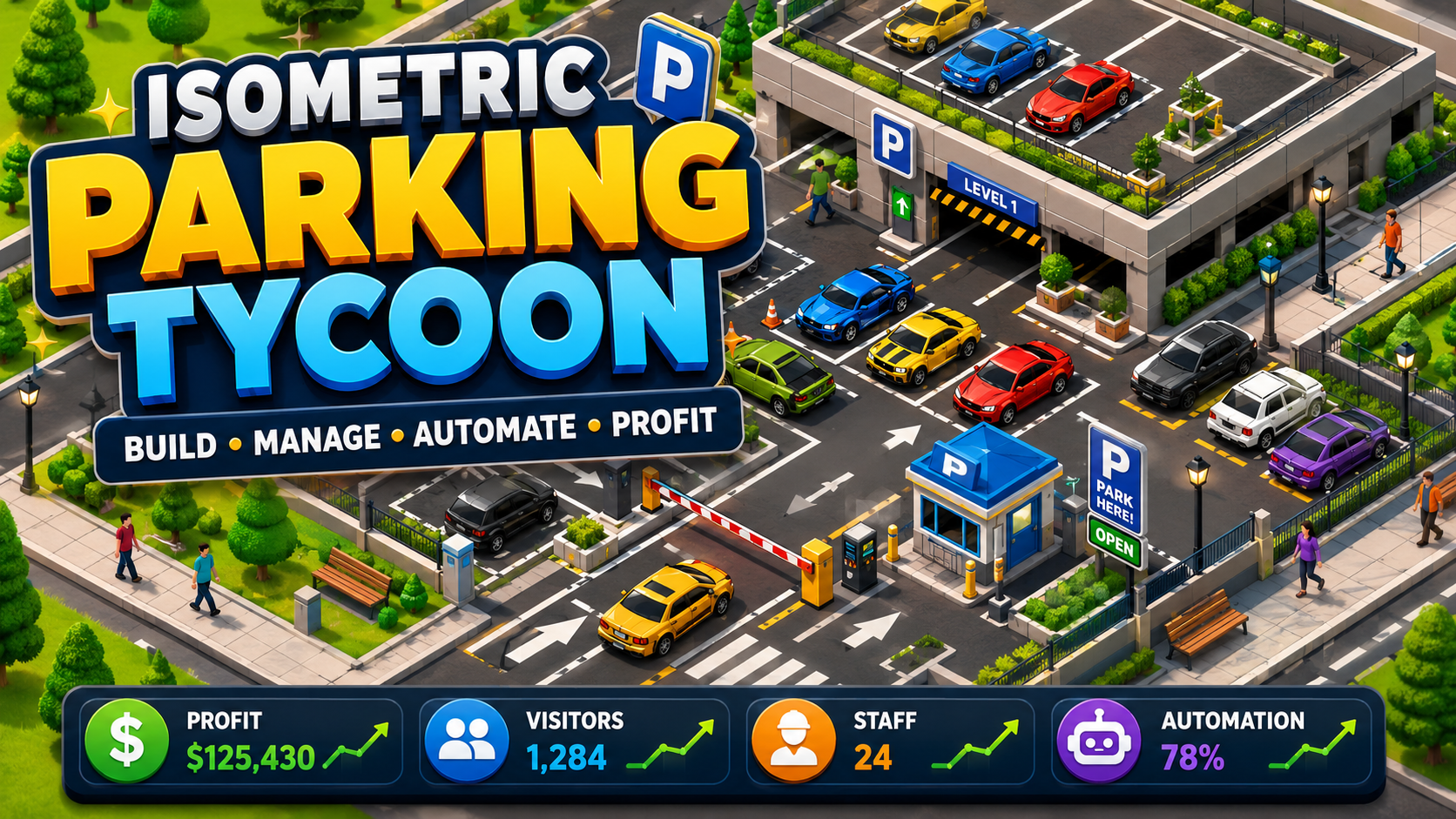
Isometric Parking Tycoon is a management and simulation game about transforming a small urban parking operation into a busy, efficient, and profitable transportation hub. Instead of simply placing parking spaces and waiting for money to increase, you are responsible for the systems that keep the entire district moving: road access, parking connectivity, vehicle flow, pedestrian movement, staffing, maintenance, pricing, cleanliness, customer satisfaction, and long-term operating costs.
You begin with a limited amount of cash and a relatively simple objective: create parking spaces that drivers can actually reach. Every useful parking area must connect correctly to the road network, which means expansion is not only about filling empty land with more spaces. Road layout, entry routes, exit routes, and the relationship between parking tiles and the surrounding street network all affect whether your new capacity can be used.
As the parking district grows, traffic becomes increasingly important. Vehicles enter the area, search for available connected spaces, park for a period of time, and eventually leave through the appropriate exit route. A poorly planned layout may provide plenty of theoretical capacity while still creating unnecessary congestion. A well-designed district can handle more visitors without turning the entrance into a traffic bottleneck.
Pedestrians are also part of the simulation. Drivers do not simply disappear after parking. People move through the district using appropriate walkable areas, helping the parking lot feel like an active urban space rather than a static collection of tiles. Roads, sidewalks, buildings, lighting, staff, cars, and visitors all work together to create a compact isometric city-management environment.
Progress is tied to your Main Office. Improving the office expands the scale of the operation and gives you access to more management options. The office becomes the center of your parking business, allowing you to review financial information, visitor activity, operations, staffing systems, and other management data while the simulation continues to run in the background.
Staffing becomes increasingly important as the district becomes busier. Cleaners help deal with litter and dirty areas. Technicians support maintenance when infrastructure such as lamps begins to deteriorate. Gate Attendants improve vehicle processing at busy access points. Hiring staff can improve operations, but every employee also creates an ongoing wage commitment, so expanding your workforce too aggressively can reduce the cash available for future construction.
The game gradually introduces automation for players who want to operate the parking district at a larger scale. Auto Maintenance can respond to maintenance pressure. Auto Cleaning can react to cleanliness problems. Auto Gate Staffing can respond to traffic demand. Coordinated Operations can evaluate multiple staffing requests together instead of allowing each system to behave independently.
Adaptive Priority adds another layer to automated management. Requests can be ranked according to current operational pressure, allowing the game to distinguish between routine problems and more urgent situations. Fairness systems help prevent one valid request from being ignored indefinitely when another category repeatedly receives higher priority.
Players who prefer tighter control over automation can use financial safeguards. Automation Cash Reserve lets you protect part of your available money from automatic staffing decisions. This makes it possible to keep emergency construction or operating capital available instead of allowing automation to spend every dollar simply because a staffing request is technically affordable.
The parking economy is not limited to construction costs. Parking fees, wages, maintenance, operational choices, visitor demand, and capacity all influence how quickly the district can grow. Smart Pricing tools allow the parking fee system to react to utilization conditions, while financial dashboards help you understand where money is coming from and where it is being spent.
Expansion is therefore a balance between capacity and efficiency. Adding more parking spaces can increase potential revenue, but spaces that are not properly connected will not solve demand. Adding staff can improve service, but staff wages continue to matter after the initial hiring cost. Increasing prices may improve revenue per visitor, but the broader operation still has to remain attractive and functional.
The game also provides management overlays and analytical tools for players who want to understand what is happening beneath the surface. Parking connectivity information helps identify which spaces are actually usable. Utilization information makes it easier to see where parking demand is concentrated. Operational dashboards explain staffing priorities, automation decisions, and financial constraints without requiring the player to guess why a particular system is behaving in a certain way.
Isometric Parking Tycoon is designed around gradual development. Early play is primarily about learning how roads, parking spaces, and basic income work together. Later play becomes more about operating a living system: handling heavier traffic, improving capacity, controlling wages, preventing maintenance problems, keeping the area clean, adjusting prices, and deciding how much authority should be given to automation.
There is no single mandatory layout. You can expand carefully and preserve cash, or build aggressively and attempt to generate enough demand to support a much larger operation. You can rely heavily on automated management or keep important decisions under manual control. The most successful parking districts are not necessarily the largest ones; they are the ones where traffic, parking capacity, staffing, maintenance, and finances continue to work together as the operation grows.
The current Parking Hub represents the first completed district in the broader Isometric Parking Tycoon project. It establishes the core economy, traffic simulation, staff management, parking systems, and operational foundation that future districts can build upon.
Whether you enjoy city builders, management games, traffic simulations, idle-style progression, or optimization games, Isometric Parking Tycoon offers a compact browser-based experience where every expansion creates new operational decisions. Start with a modest parking area, connect it to the city, watch vehicles and pedestrians move through the district, improve your facilities, automate routine work, and turn a simple parking lot into a carefully managed urban business.
⌨
Controls
Touch or mouse: Select tools, place roads and facilities, open the Main Office, manage staff, change automation settings, and inspect the parking district.
Drag: Move across the game area when needed.
Office tabs: Open Overview, Finance, Visitors, and Operations management panels.
Build toolbar: Select roads, walkways, parking spaces, lamps, the Main Office, and other available construction options.
Mobile: The complete game can be played using touch controls in a supported mobile browser.
▶
How to play
Start by building a connected road and parking layout. Parking spaces must be connected to the active road network before visiting vehicles can use them.
Watch incoming vehicles and expand capacity when available parking begins to fill. Avoid building isolated parking tiles that cannot be reached from the entrance and exit network.
Use the Main Office to review your district. The Overview, Finance, Visitors, and Operations tabs provide information about capacity, income, staffing, maintenance, demand, and automation.
Earn cash from parking activity and reinvest it into additional parking spaces, roads, walkways, lighting, office upgrades, and other infrastructure.
Keep the district operational as it grows. Hire a Cleaner when litter becomes a problem, a Technician when maintenance requires attention, and a Gate Attendant when entrance demand becomes heavy.
Use automation carefully. Auto Cleaning, Auto Maintenance, and Auto Gate Staffing can reduce repetitive management, while Coordinated Operations and Adaptive Priority help determine which staffing request should be handled first.
Monitor wages as well as hiring costs. A staff member that is affordable to hire may still create ongoing financial pressure.
Adjust parking fees and use management information to balance utilization and revenue.
Continue expanding until the parking district becomes a high-capacity, efficient urban operation.
✦
Tips
Connected parking is more valuable than raw parking capacity. Always confirm that new spaces can actually be reached by vehicles.
Do not spend all available cash on construction. Keeping an operating reserve makes it easier to respond to staffing or maintenance problems.
Watch the entrance when utilization becomes high. A larger parking lot is not useful if traffic cannot enter efficiently.
Use the Main Office regularly. The management panels contain useful information about demand, finances, staffing pressure, and automation decisions.
Hire staff according to actual operational pressure rather than hiring every role immediately.
Automation is powerful, but it can also spend money. Use Cash Reserve and other management safeguards when you want automatic systems to remain financially conservative.
If the game becomes busy, focus on improving flow before adding even more capacity.
Parking fees, wages, infrastructure costs, maintenance, and demand all interact. A profitable district usually comes from balancing several systems rather than maximizing only one.