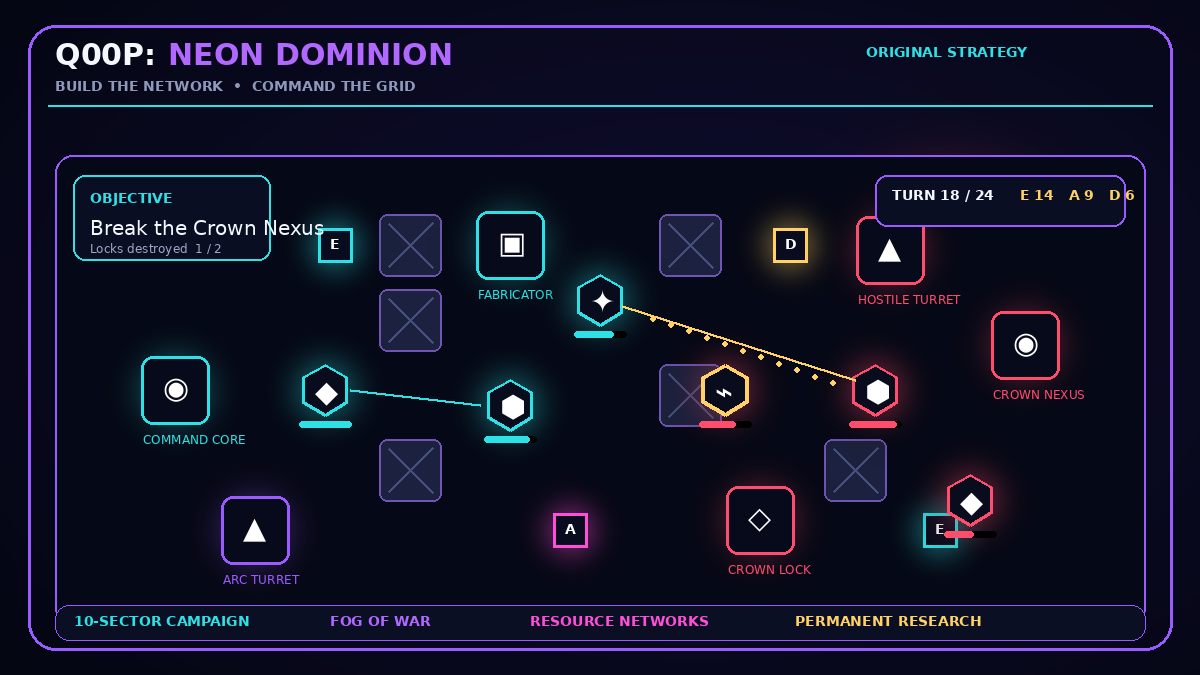
Build scope for this Neon Dominion economy guide
This economy guide is tied to Q00P: Neon Dominion v1.0.0, release ID 20260801044240-nw1pdmr4xtkkl91s, validated on August 1, 2026. Its release archive SHA-256 is 5acf6ac6774574479b8b6f503706b19232a24b1ae2b0b182ad0be56442a1b030.
The current package stores campaign progress and research locally and implements Energy, Alloy, Data, relay capture, construction, tactical protocols, and the Crown AI inside a self-contained HTML5/Canvas runtime. No CDN, API, npm, Vite, tracker, account, or internet connection is listed as a gameplay dependency. The resource advice below is therefore anchored to that current release.
The battlefield in Neon Dominion is also an economy map. Units win local fights, but relays and structures determine how many useful actions can be repeated over a long mission. A player who captures everything without defending it creates an unstable network. A player who never expands gives the Crown AI time to outproduce the starting force. Strong resource play sits between those extremes.
Neon Dominion uses three resources: Energy, Alloy, and Data. Controlled relays generate income at the start of each turn. Structures and network position influence where you can deploy, defend, and continue expanding. This guide explains how to build a resource network that supports the objective instead of becoming a collection of isolated nodes.
Understand what each resource enables
Energy is a general operating resource. It supports many actions and becomes valuable whenever a turn includes construction, deployment, or repeated pressure. Alloy is the material side of expansion. It matters when the army needs new units or when the battlefield requires structures. Data powers tactical protocols and creates sudden advantages that ordinary movement cannot provide.
The exact best ratio changes by sector. A long defensive mission may need steady Energy and Alloy for replacements and fortifications. A shielded objective may increase the value of Data because EMP Cascade, Deep Scan, or another protocol creates a safer breach. A relay-control mission rewards flexible income because the front can move several times.
Do not judge a relay only by its color. Judge it by what the next three turns are likely to require.
Capture nodes that connect to a plan
The nearest relay is often a good first target, but distance is not the only factor. A useful relay should satisfy at least two of these conditions:
- It produces a resource you need soon.
- It can be reached without exposing the capturing unit.
- It lies on the route toward the mission objective.
- It extends vision into an important area.
- It can be defended from cover or by a nearby structure.
- It creates a future location for deployment or construction.
A distant relay that cannot be held may cost more movement than it returns in income. The Crown AI can also use the distraction to pressure your Core. Capture outward in connected steps so each new node benefits from the one before it.
Treat the Pulse Runner as an economic unit
The Pulse Runner is a capture specialist, not merely a fast attacker. Its movement lets it take an unoccupied relay, contest a weak flank, or recapture a node after the main army moves on.
The Runner should rarely remain on the same safe relay for the entire mission. Once a durable unit or structure can hold the position, move the Runner toward the next economic opportunity. This creates a relay chain without forcing the slower frontline to spend every turn traveling.
Speed also makes the Runner useful for denial. Capturing a Crown relay for even a short period can reduce hostile income and force a response. The move is worthwhile when the Runner has an escape route or when the distraction supports the main objective.
Defend high-value relays with the right assets
Not every relay deserves the same defense. A node close to the original Core can often be recaptured quickly. A central relay that connects two fronts may justify a Sentinel, turret, or Shield Pylon.
Aegis Sentinels are strong relay holders because they control space and survive pressure better than Runners. Arc Turrets punish predictable approaches. Shield Pylons add armor and gradual repairs to nearby assets. Walls and adjacent structures provide cover, so a relay near terrain can become a defensive anchor with less investment.
Avoid stacking every defensive asset around one safe node while the rest of the map collapses. The goal is to make each important relay expensive for the Crown AI to take, not impossible to attack.
Build forward Fabricators where they save turns
A War Fabricator changes the geography of reinforcement. Without one, a replacement unit may spend several turns walking from the original Core to the active front. A forward Fabricator converts resources into time by deploying closer to the objective.
The best location is usually behind the frontline, connected to the network, and close enough to matter without being the first structure attacked. Building directly beside an exposed relay can create two vulnerable assets instead of one strong position.
Ask a simple question before construction: how many movement turns will this Fabricator save during the rest of the mission? If the battle is nearly over or the front is moving elsewhere, save the resources. If the sector is long and replacements are likely, the investment can pay for itself repeatedly.
Use economic structures as part of defense
Reactors, foundries, and network structures should not be placed as if the battlefield were empty. A resource structure next to cover, a Shield Pylon, or a protected lane is more reliable than the same structure on an exposed edge.
Structures can also shape movement. An adjacent asset may provide cover, block a route, or create a compact position where a Sentinel and Lancer support each other. The economic and tactical functions should reinforce one another.
Do not create a dense cluster that allows one hostile push to disable the entire network. Keep enough spacing and alternate routes so losing one tile does not disconnect every forward option.
Save Data for moments that change the map
Data is tempting to spend as soon as a protocol becomes available. A stronger habit is to identify the map state each protocol can reverse.
EMP Cascade can open a route through active defenses. Repair Pulse can preserve a frontline that would otherwise collapse. Deep Scan can reveal threats before they enter firing range. Overclock can create an aggressive timing window. Hardlight Shell can protect an asset during a critical exchange.
Saving Data does not mean refusing to use it. It means using it when the effect changes the mission rather than when it merely improves an already safe turn.
Compare income with replacement cost
A network is healthy when it can replace expected losses without stopping all other progress. If one destroyed unit consumes several turns of income, expansion may be too slow or the army may be taking bad fights.
After each Crown turn, review:
- Which resource is limiting the next important action.
- Whether a relay was lost or is likely to be contested.
- How many turns a replacement unit would need to reach the front.
- Whether a protocol can prevent a more expensive loss.
- Whether a structure is still contributing enough to justify defending it.
This review turns the economy into a decision system instead of a number display.
Avoid the three common network failures
Overexpansion
The army captures several relays but cannot defend the paths between them. The Crown AI attacks the weakest connection and forces repeated recaptures. Fix this by expanding in connected steps and pausing to fortify a central node.
Static defense
The player builds a strong position around the Core but leaves every neutral relay to the Crown. The defense survives, yet hostile production keeps increasing. Fix this by sending a Runner toward a safe economic flank while the main force holds.
Resource imbalance
The player owns several relays but still cannot execute the desired plan because the income is concentrated in the wrong resource. Fix this by deciding what the next structure, unit, and protocol require before choosing the next capture target.
Adapt the network to the mission type
In a core assault, the network should support a forward breach and fast reinforcements. In a survival defense, it should produce replacements while strengthening lanes around the protected asset. In relay-control missions, mobility and recapture matter more than one permanent fortress. Against shielded command nodes or generator objectives, Data and Hacker support can become more valuable than raw unit count.
The mission objective determines which part of the network is essential. A relay far from the victory condition may be optional even when it is easy to capture.
Research for a stronger campaign economy
Victories award Research that permanently improves later missions. Economy upgrades can make long sectors more forgiving because every controlled relay produces more useful options. Rapid Fabrication and combat upgrades can also improve economic efficiency by reducing reinforcement delays or helping units survive.
Choose Research based on the campaign pattern you prefer. A careful player may benefit from reliable income and defenses. An aggressive player may use faster deployment and stronger units to convert early captures into a quick advantage.
A strong Neon Dominion resource network is not the one with the most icons under friendly control. It is the one that produces the right resources, protects the routes that matter, and places reinforcements close enough to influence the objective. Capture with purpose, defend selectively, and use Data when it changes the shape of the battle.